3 Activities to Teach Irony - Engaging Ways to Help Students Master Irony

Have you ever been faced with a classroom full of blank or even confused faces when you ask students to find, discuss, or analyze the irony in a piece of literature?  I know I have!  Irony seems to be one of the concepts that students struggle with year-after-year.  That's why I thought it was time to develop some hands-on and engaging lessons to get students mastering situational, verbal, and dramatic irony!  I thought I'd share some of the ideas with you today. I hope they'll help your students get excited about irony, too!

IDEA #1:  Irony Hunt
Send students on a search for irony with this fun activity.  First, you'll need to create a set of irony cards. I've found 12 cards to be the perfect amount.  On some of the cards write down situations that are truly ironic.  Then, on other cards write about situations that are not ironic...maybe just bad luck.  Then, create a sheet where students can record whether or not each card contains irony. I like to include a section on the worksheet where they can explain their answer, too.


Next, place the cards around the room.  I copy two sets so that students can easily spread out while completing the activity.  For an extra fun challenge, you can actually hide the cards.  You could tape some under desks, behind the door, above the windows, or inside the class novel.  Of course, you don't actually need to hide them.  You can also put them in plain sight for students to easily find.  

Then, instruct students to find and read all 12 of the cards.  After they read each card have them note whether or not the situation is ironic. 


Students love this activity because it gets them out of their seats.  It's also a great way to get students thinking about irony.  

If you're looking for a set of cards already created for you and your students, you can find them in my Irony Mini-Unit resource.


IDEA #2:  Irony Flip Cards
Students love making simple irony flip cards.  All they need to do is fold a piece of paper in 3 sections lengthwise.  Then, have students label each section with a different type of irony:  situational, dramatic, and verbal.  Next, have students add a little piece of tape so that they create a flip card that they can rotate in response to irony clues that you read to them.  

Speaking of irony clues, you'll want to prepare at least 15 irony clues to read out loud to the class.  I like to keep them pretty short like: "There is an outbreak of roaches in a pest control office."  I also like to use examples from books or stories that we've studied.  For instance, since we read My Brother Sam is Dead in class, I might write one clue that says: "Mr. Meeker sympathized with the British, and then he died at the hands of his allies."
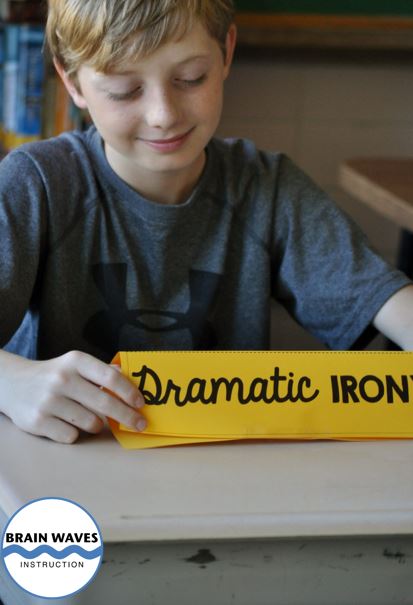
Make teaching about irony hands-on and fun!  Check out this activity where students make flip cards that they can use in response to irony clues that you read.  So engaging!

After students have their flip cards ready, and you have a set of clues, you're set to do the activity.  Just read the clues and have students flip their cards to display which type of irony is in each example.


As an extension, you could challenge students to write a few ironic situations themselves.  Then, they could read them to the class while their peers flip their cards.  

Don't worry, I have a set of clues and even a flip card that's ready for students in my irony mini-unit if you'd prefer to skip the prep and get right to the teaching.  

IDEA #3:  Irony Foldable
I've found that foldables are incredibly motivating for students.  Students get a little giddy when I bring out the scissors and glue sticks...and I can't blame them.  Hands-on activities are always the best!  That's why this final idea is always a hit with students.  

First prepare a set of shutter cards with the beginning of an ironic situation on one side of the shutter cards.  For instance, you might write, "Your team wins the championship and your couch says..."  Then, have students finish the situation on the other side of the shutter cards.  Students might write, "You guys should try much harder next time." 


Once students have written the ending for 3 ironic situations, have them cut apart the shutter shapes and glue them onto a piece of paper so that the shutters open in the middle.


Finally, have students explain why the situation is ironic under the shutter shapes.


The end result is a pure demonstration of students' understanding of irony.


There you have it, 3 easy and fun ways to teach irony.  The coolest part is that once students have completed these lessons, they actually retain their learning.  There's nothing better than hosting discussions about irony during the next literature unit.  No more blank or confused faces.  Just a whole lot of hands in the air!  

I hope you've found some ideas that might work in your classroom.  If you're looking for more, then this 3-Day Irony Mini-Unit might be what you need.  Not only are these activities ready for you and students, there's also a ton of instructional lessons.  Guided notes, reading passages, writing activities, and so much more!


Thanks so much for stopping by!

Mary Beth

Understanding irony is essential when studying literature...that's why lessons about irony are so important.  Here are 3 really simple and super fun ways to study irony.  Help students master situational, dramatic, and verbal irony with these fun irony lessons!

P.S.  You can find a ton more FUN literary devices mini-units in this bundle.  Just click HERE to learn more.


Free Stackable Classroom Posters!

You know how they say that "necessity is the mother of invention?"  Well, that was definitely the case when I was faced with a super narrow bulletin board in the classroom.  I was perplexed about how to use the space.  Then, I remembered how much I love displaying motivational quotes in the classroom and the idea of the stackable poster was born. I decided to create a long, narrow poster with an inspirational quote.  


Then...I couldn't stop creating them!  Seriously...it's becoming an obsession! That's actually a good thing for you, because I have a bunch that you can download for FREE!  


They're super simple to install.  First, just cut out each of the poster strips.  (I've provided gray lines for you to cut along.)


Next, lay out the poster on a table or floor (be sure to add a little space between each poster strip).  Measure the assembled poster to make sure that it will fit where you want to display it.  The poster measures approximately 43 inches long and 10 1/2 inches wide when it is assembled.

Then, begin stapling or taping the poster up on a wall, door, or bulletin board.  I made a spacer template to that I could make sure that the poster edges lined up.


I created a tiny sliver of a piece of paper to serve as the spacer guide for each strip of the poster, too.


Then, I realized that I could also turn the strips over and tape the poster together on the floor first, and then hang it up.  Either way...the assembly process is quick and easy!


Once the first poster was hung on the bulletin board and I saw how modern and fun it looked, I went a little "stackable-poster-crazy" and made a bunch of them!


The coolest part is that you can display them in so many places!

You can even attach a string to the top and hang it around your classroom.


Ready to download your own set of FREE stackable posters?  Well, then you're in luck!  I've put together 3 of the posters in this EXCLUSIVE FREEBIE.  Just click HERE to download your posters....but wait...


I hope they make your students happy!  I hope they make you smile!  I hope they add a little fun to your school year!

Thanks for stopping by!

Mary Beth


Check out this FREE set of 3 stackable posters!  Each includes an inspirational quote.  Just hang them in your classroom for a modern twist on the motivational quote!


P.S.  Be sure to grab your posters here, too!


How to Create a Positive Classroom Culture with S.T.A.R.


I'm super psyched to be linking up with the Secondary Smorgasbord (thanks ELA Buffet and Desktop Learning Adventures for getting this blog linky started) today!  We're all discussing ways to create a positive classroom culture.  

As teachers we all strive to create a classroom that brings the very best out of our students.  We all want our classrooms to be a place where students feel safe and encouraged.  Here's the thing though, a positive classroom culture is not something that happens by accident.  It's something that needs to be nurtured and built throughout the school year.  

Today, I thought I'd share four really easy ways to do just that.  Each technique works together to form the word "STAR."  
S - Set Goals
T - Team Building
A - Accentuate the Positive
R - Reach Beyond the Classroom

I like to infuse the S.T.A.R. positive classroom techniques in my lessons all year long...and I hope you'll find some that can work in your classroom, too!


Setting goals is essential to a positive classroom culture.  That's because when we set intentions to better ourselves, we naturally improve our classroom community.  While it's important to teach students how to set, measure, and reflect on goals, I think it's also powerful to set goals as an educator.  

As teachers we naturally set goals all the time.  However, have you ever shared your goal setting process and reflection with students?  This can be a game changer.  The next time you set goals whether it be for a unit you are planning or school event or for students' success rate on an assessment, share it with students.  Show students how you set specific, measurable goals, and then, show them how you reflect back on your goals.  Modeling goal setting is so powerful!

Here's a goal setting idea that's perfect for students at the beginning of a new school year.  With this activity students progress through a goal-setting guide. 


 Then, they create a fun speech bubble with their goal inside.  As a class they combine their goals on a bulletin board.  In the center of the bulletin board is a quote poster that says, "Take Our Word For It, It's Going to Be a Great Year."  This activity helps students not only set goals but it projects a spirit of positivity right from the start of school.  You can find a FREE download of this goal setting and bulletin board resource HERE. 


Team building is essential to a positive classroom community because when students have strong skills to work collaboratively, the entire classroom is a more positive place to learn.  Encouraging teamwork among students helps them improve their speaking, listening, and social skills.  One of my favorite ways to foster team building is with lessons that not only help students master critical ELA skills, but also encourage them to work together as a team.  

Here's one of my favorites.  In this lesson students practice reading comprehension and figurative language while they work cooperatively with their peers.  First students work together to put a fable in the correct order.  Then, they answer questions as a team.  Finally, they reflect on their experiences as a team using figurative language while making a pennant banner.  


This activity is just one way to encourage students to work together as a team.  You could also find a ton of team building activities at this website.  I've found that making time to teach students how to work together has done wonders for creating a positive classroom culture!


Let's face it, if we want our classrooms to be positive places then we need to make it a practice to recognize students' individual contributions.  It can be as simple as spending a portion of the class period highlighting students or creating a bulletin board filled with news clippings, pictures, and examples of students doing awesome things, or writing personalized notes on students' papers recognizing their efforts.  Or, it can be as elaborate as assemblies or awards.  The idea is to make time to point out what kids are doing right!

Encouraging students to accentuate the positive with one another is also a critical component of creating a positive classroom community.  I love getting students to do that with this simple activity.  All you have to do is hand out a piece of colored paper to each student.  Have them write their name creatively and boldly at the top of the paper.  Then, have a discussion with students about what makes a good compliment.  Brainstorm meaningful compliments together.  Then, explain to students that they will be writing compliments to their classmates.  Have students place the paper they created on their desk and instruct them to move to a different desk.  At that desk they should write a meaningful compliment to their peer.  


Then, challenge students to rotate around the classroom until they have written a compliment for everyone.  Students love this activity.  Their compliment-filled-paper becomes a treasured item and a reminder of the positive classroom environment where it was created!  If you'd like a FREE version of this activity along with others that promote kindness in the classroom, just add your email address below and check your email inbox!


    If you happen to work with adolescents, you know that they can be a bit self-absorbed.  Students are often stuck in their own world.  However, I've found that if prompted, they have a deep desire to make a difference in their schools, towns, communities, and world.  That's why my final tip for creating a positive classroom culture is to set up opportunities for students to reach beyond the classroom.  Give students a chance to make a positive difference in others' lives and see how that impacts the culture in your own classroom.

    Here are some ideas to help students reach beyond the classroom:


    --- Have students write letters or design cards for residents in a local nursing home.
    --- Set up a reading-buddy program with a lower grade in your own school or district.
    --- Task students to complete a school beautification project.

    --- See if a local community organization needs help with their newsletter and have students write articles for the publication.
    --- Task students to complete random acts of kindness in their school, home, and community.


    --- Have students research community service projects that matter to them (Case for Smiles, Room to Read, Soles4Souls) and complete a community service project together.
    --- Let students turn their poems into place mats that can laminated and donated to programs like Meals on Wheels or Shelters providing food.
    --- Encourage students to assemble appreciation gifts for pivotal people in the community like police officers and fire fighters.


    The ideas for helping students help others are endless...and that's a good thing!  Giving students an opportunity to see the good in themselves by doing good for others is essential to creating a positive classroom culture!

    I hope you've found some easy ways to create and nurture a positive culture in your classroom.  If you're on the hunt for even more ways to make your classroom a better place to learn, be sure to sign up for the free set of kindness activities!


      Thanks for stopping by,

      Mary Beth


      Nonfiction Text Features Bulletin Board


      Don't you love a bulletin board that is happy and bright...and educational?  

      Turn a set of 12 nonfiction text features posters into a bulletin board that can be displayed all year long!

      I know I do! Unfortunately, my husband (also a teacher), did not have the same standards for bulletin boards. In fact, take a look at the bulletin board that I'm pretty sure he had in his classroom for at least five years! Yes, five years! 


      Every summer as the new school year was approaching, I would beg him to let me change it for him...and each year he politely refused my help...until this year. Yes, miracle of miracles, my husband agreed to let me change up his bulletin board! 

      I didn't waste any time gathering materials for a bulletin board that would be more aesthetically appealing, but still be education. I assembled the following items: 12 nonfiction text features posters, patterned scrapbook paper, bulletin board paper, tape, glue, scissors, and string.

      All you need to create a fun nonfiction text features bulletin board are posters, scrapbook paper, glue, string, and a stapler.

      Then, I glued each poster to a piece of patterned paper. Since the scrapbook paper was a little long, I trimmed it first. Next, I stapled the posters to the bulletin board in a grid pattern (of course, these would be fun strung along a clothesline on the bulletin board, too).

      Glue the nonfiction text features posters onto fun scrapbook paper before stapling them to the bulletin board.

      Oh, and I had to get creative with the bulletin board trim because I knew my husband wouldn't have any. So, do you remember how I trimmed the scrapbook paper to fit behind the posters? Well, I just saved those trimmings and lined them around the board. This creates a fun patchwork border.

      If you don't have strips of traditional bulletin board borders, just use 3 1/2 inch pieces of scrapbook paper.  Stapled together, they give a super fun patchwork look!

      Pretty soon the posters were up...but I needed a sign.

      Display a set of 12 nonfiction text features posters on your classroom bulletin board for a fun display that you can leave up all year long!

      That's when I found this AMAZING set of FREE printable chalkboard letters! They were perfect, so I printed out enough letters to make the sign. As I cut them out, I also cut a little tab above each letter. I knew that this would make assembling the banner of letters easier later.


      In no time I had all the letters I needed. 

      Easy nonfiction text features sign for displaying on a bulletin board or in your classroom.

      Then, I folded over the tab on each letter. I placed the string under the tab and taped it down.


      Just like that my signs were ready and strung up above the posters.


      And...the mission of a creating a bright, fun, and educational bulletin board was accomplished. However, that wasn't even the best part!

      Looking for a fun and educational bulletin board?  Then, you're going to love this idea!  Just display a set of bright and colorful nonfiction text features posters.  String a sign along the top...and help students learn about nonfiction text features all year long!

      The best part was the remnants of the old bulletin board in the trash can. It was reason enough to celebrate! 


      If you're looking to spruce up one of your bulletin boards (or your spouse's), then you can download all 12 of the Nonfiction Text Features posters for FREE HERE (for a limited time).

      Create a fun and educational bulletin board with this set of 12 nonfiction text features posters!

      Thanks for stopping by,

      Mary Beth


      P.S.  If you're looking for more fun ways to help students learn about nonfiction, then, you might want to check out these popular resources:


      CLICK HERE to LEARN MORE

      CLICK HERE to LEARN MORE

      CLICK HERE to LEARN MORE


      Pop Up

      Related Posts Plugin for WordPress, Blogger...